01 // Motion
Jungle
Fast broken beats and detailed edits transport fragments between branches, species and generations.
PN-008 // Distributed memory
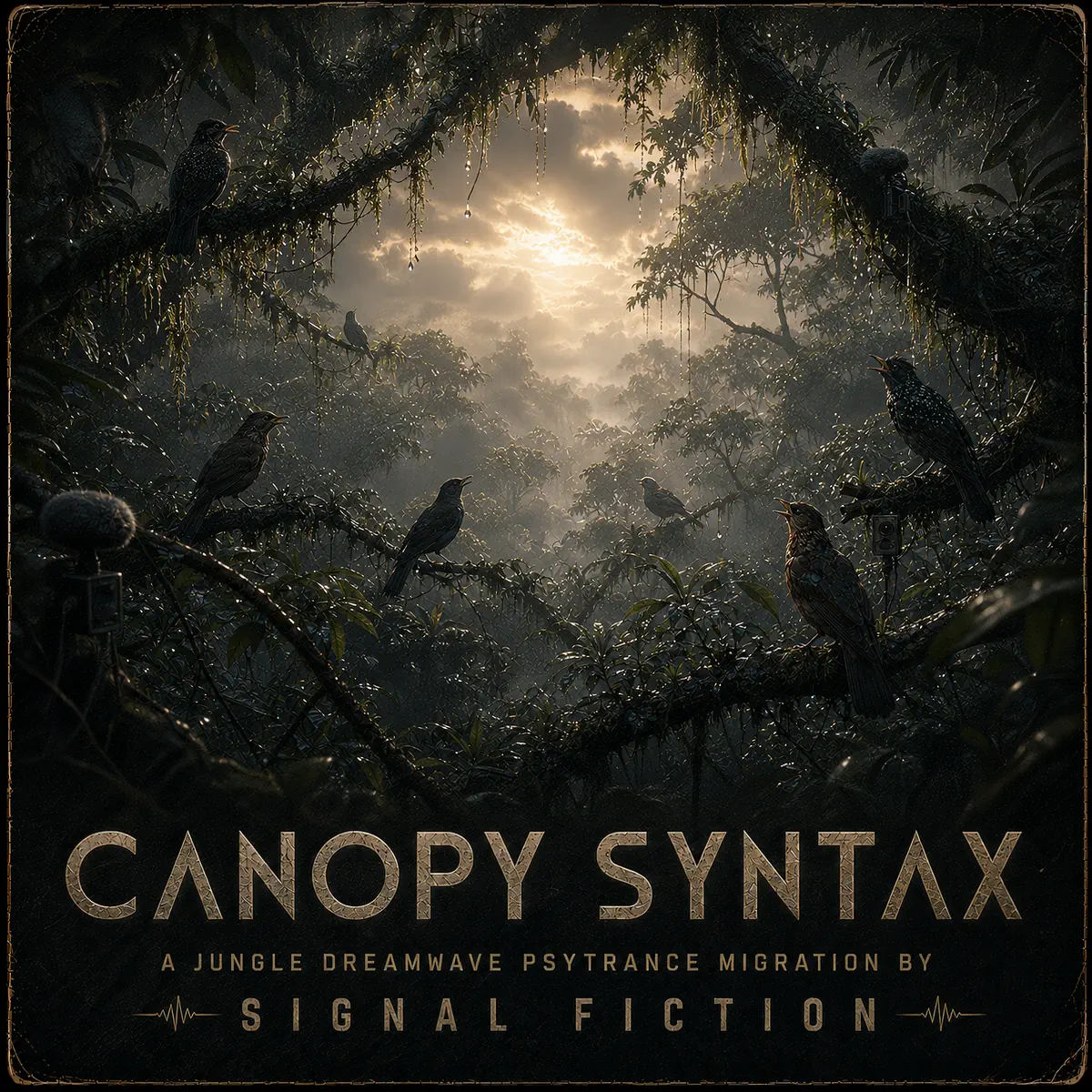
A Jungle Dreamwave Psytrance Migration by Signal Fiction
13 tracks // 00:51:08 // Parallel Names
No bird knows the sentence. The canopy says it anyway.
Rainforest birds carry pieces of old field-recording speech between species, locations and generations. An analysis system begins hearing a sentence no one recorded in full.
First heavy rain // Annual convergence
Across decades, mimic-capable birds absorb fragments of routine speech from human field recordings.
The sounds pass between birds, species and generations, changing with every transfer. During an annual gathering after the first heavy rain, calls from separate parts of the canopy overlap while a bioacoustic system searches for phonemes and relationships.
It eventually offers an apparent sentence: "Can you still hear me?" No surviving recording contains those words in that order, and no individual bird carries the whole phrase.
If a voice survives only as fragments distributed across other living things and assembled by software, whose memory is it?
Canopy migration // 13 tracks
Five movements carry the listener through unparsed ecology, borrowed fragments, distributed grammar, an impossible sentence and the afterimage left when explicit language disappears.
I // Unparsed canopy
The first heavy rain activates birds, insects and forest rhythm. Nothing yet implies language.
I // Unparsed canopy
Calls repeat, migrate between positions and persist as a living archive without a single keeper.
I // Unparsed canopy
Distant calls begin resembling one another while still sounding like ordinary ecology.
II // Borrowed fragments
One call acquires a speech-like edge, plausible as a phoneme but not an intelligible word.
II // Borrowed fragments
A recognisably human female timbre enters, but its vowel shapes carry no lexical meaning.
II // Borrowed fragments
The first source-language evidence appears in separated traces of "still" and "recording."
III // Distributed grammar
The fragment "again" travels between separated canopy positions. Repetition begins behaving like transfer.
III // Distributed grammar
"Can" and "you" emerge independently as the system starts correlating events across the forest.
III // Distributed grammar
"Hear" and "me" join the available fragments. The listener begins suspecting an order.
IV // The impossible sentence
Every required component becomes recognisable, but remains filtered, degraded and spatially separate.
IV // The impossible sentence
The fragments align into "Can you still hear me?" without revealing one intact source or speaker.
V // Afterhearing
Intelligible language vanishes. Bird calls and rhythmic accents retain only its cadence and expectation.
V // Afterhearing
The reconstruction is gone. Bright post-rain ecology returns, but the listener may continue completing the pattern.
Sonic architecture // 170 BPM
Canopy Syntax is instrumental-first electronic music with sparse processed field-recording speech fragments.
Crisp chopped breaks, rolling sub bass and organic percussion move calls through the stereo field. Warm analog harmony supplies the emotional residue of the absent human source. Recursive sequences and precise psytrance kicks grow more assertive as the fragments begin to align.
Bird calls are structural material. They establish location, repeat across distance, interact with the drums and remain after the software's proposed sentence has disappeared.
01 // Motion
Fast broken beats and detailed edits transport fragments between branches, species and generations.
02 // Residue
Analog chords, filtered arpeggios and restrained melody hold the distance of a missing human voice.
03 // Correlation
Recursive acid sequences and controlled builds represent the system testing possible relationships.
Interpretation // No confirmed source
The same evidence supports three readings. The album presents the fragments and never selects a definitive answer.
Reading 01 // Living archive
The birds collectively preserve human material that no individual carrier contains in full.
Reading 02 // Analysis error
The software joins unrelated fragments and manufactures continuity that never existed.
Reading 03 // Afterhearing
The system suggests a pattern, and the person listening supplies the sentence.
Afterhearing // Post-rain canopy
The reconstruction layer disappears before the album ends.
Phantom Sentence keeps only stress, timing and contour. Postrain Afterhearing returns to birds, insects, dripping leaves and bright electronic motion with no explicit human voice.
Once heard, can the sentence become noise again?
Signal source
Signal Fiction makes electronic music about memory, identity, desire and the shifting boundary between human experience and digital existence.
Each album is shaped around the story it needs to tell, while the questions underneath remain connected.
AI tools support composition, performance and visual development. The lyrics, concepts, narrative design, artistic direction, curation and final decisions remain human-led.